


For scaling B2B businesses, hitting the operational ceiling of a SaaS commerce platform is a common growth challenge. Initial simplicity can give way to costly workarounds and stifled innovation. True commerce modernization begins by recognizing the critical signs that your business needs a more open, flexible, and powerful foundation to reduce total cost of ownership (TCO) and accelerate growth.
Key Takeaways:
- If you rely on a patchwork of expensive apps for customer-specific pricing, your TCO is likely spiraling out of control.
- When launching new brands or regional stores requires a separate platform instance, your architecture is limiting strategic growth.
- Fulfillment bottlenecks and brittle ERP connections are clear indicators that shallow, pre-packaged integrations are failing your operations.
- A lack of direct control over your data layer makes it impossible to prepare for future innovations like agentic commerce and advanced analytics.
The promise of SaaS commerce is seductive: fast launch times, low initial overhead, and managed infrastructure. It’s an ideal starting point. But as B2B complexity grows—with unique customer catalogs, multi-brand strategies, and deep ERP dependencies—that simplicity becomes a cage. You start spending more time and budget on forcing the platform to fit your business, rather than powering it. This is the moment for a strategic pivot toward commerce modernization.
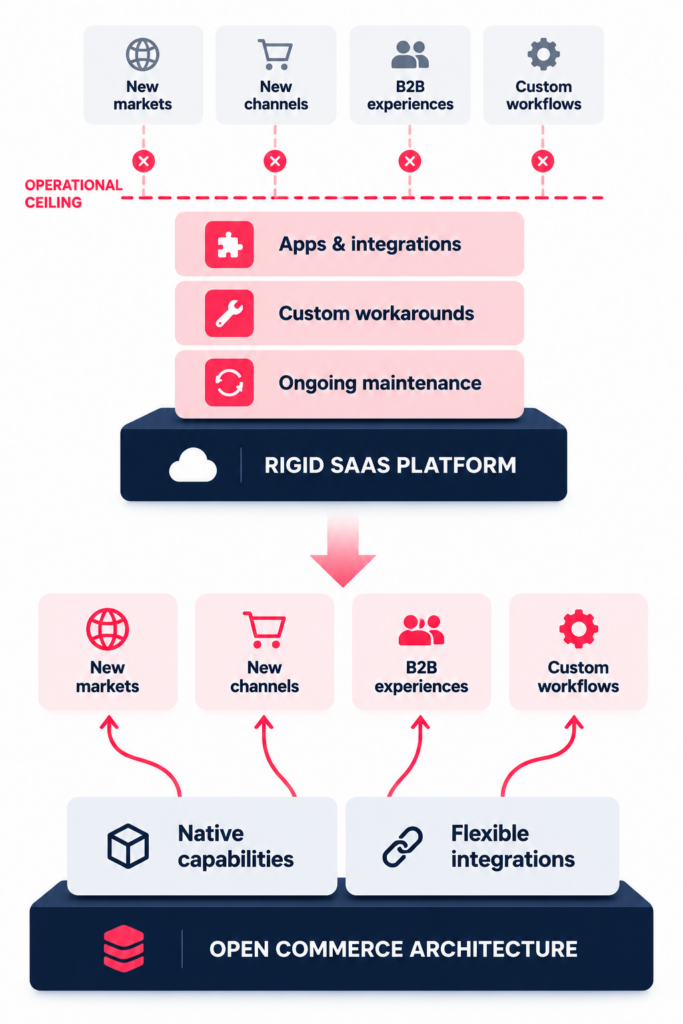
At BOLDEST, we see this inflection point often: the challenge isn’t simply that a commerce platform has become limiting. It’s that the architecture around it can start dictating what the business can and cannot do.
Sign 1: Complex Pricing Becomes a Costly, Brittle Patchwork
Your B2B sales model depends on customer-specific pricing, tiered discounts, and complex quote-to-cash processes. Initially, you solved this with a few marketplace apps. Now, your pricing logic is a fragile web of third-party extensions that often conflict, require constant maintenance, and inflate your TCO. For your finance team, it’s an unpredictable expense; for your tech team, it’s a source of constant technical debt.
The Solution: Move complex pricing and promotion logic closer to the commerce core. A platform with native rule-building capabilities can give commercial teams more control without relying on a growing stack of third-party apps or custom code.
Sign 2: Your Multi-Store and Global Ambitions Are Stalled
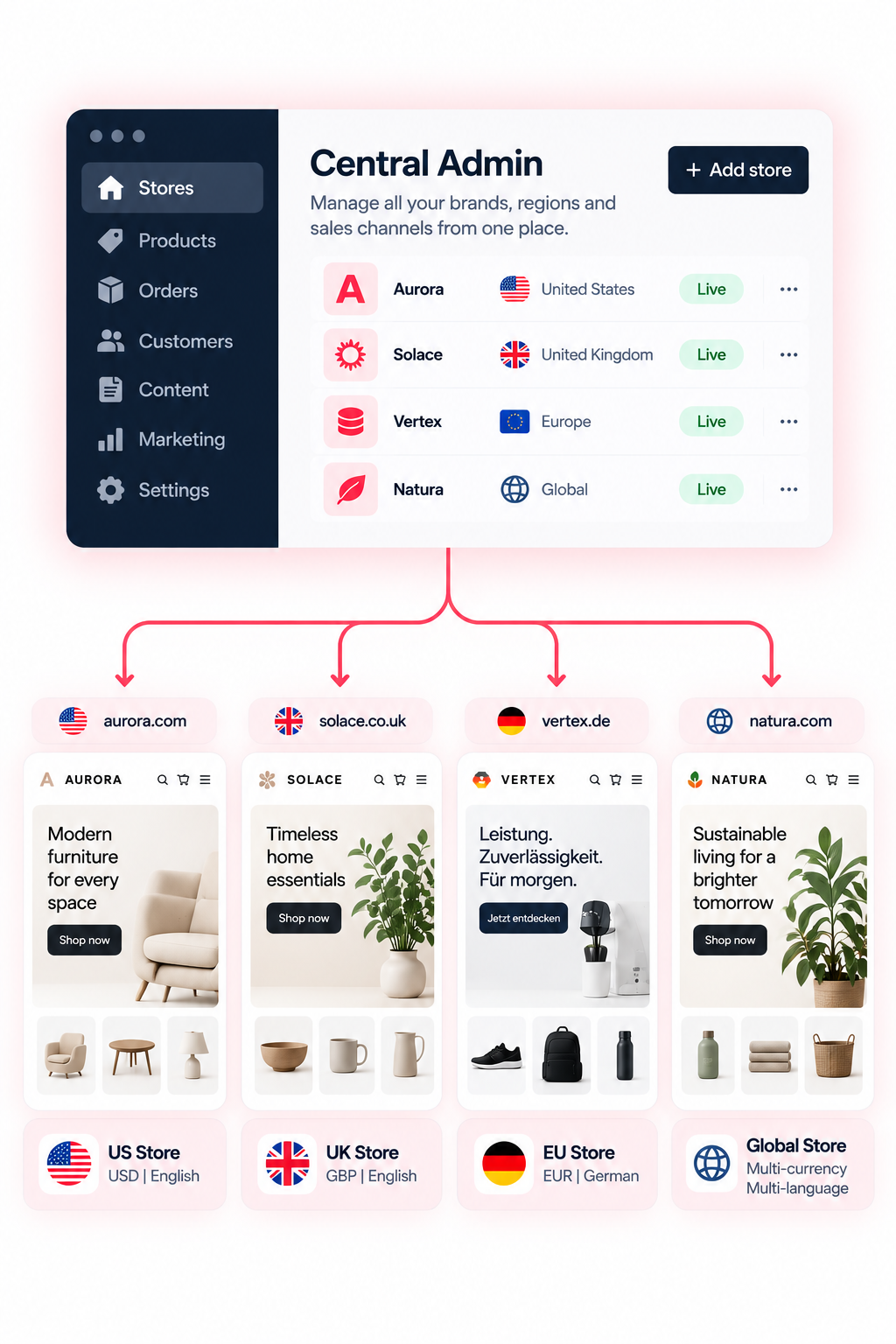
Your CEO has a vision to expand into new regions or launch a distinct sub-brand with its own catalog, currency, and customer experience. But on your current SaaS platform, this means spinning up an entirely new, siloed instance. This duplicates effort, fractures customer data, and makes unified reporting nearly impossible. The platform’s architecture is becoming a constraint on your growth strategy.
The Solution: A platform built for enterprise agility supports multi-store, multi-brand, and multi-country operations from a single backend. With native multi-store and sales channel capabilities, you can manage distinct storefronts, languages, currencies, and domains without fragmenting your core operations, enabling the rapid global expansion your leadership demands.
Sign 3: Fulfillment Bottlenecks Expose Shallow Integrations
Your ERP is the heart of your operation, yet your SaaS platform’s integration is superficial and unreliable. Data synchronization is slow, inventory levels are often inaccurate, and order fulfillment workflows require manual intervention. Your CTO knows these brittle, point-to-point connections won’t scale and are a constant risk to business continuity. Every platform update threatens to break a critical process.
The Solution: Escape the limitations of pre-built connectors with an API-first, headless-ready architecture. This approach ensures your commerce platform can integrate deeply and seamlessly with any complex IT landscape—ERP, PIM, OMS, or CRM. It transforms your platform from a standalone channel into a fully integrated component of your enterprise technology stack, delivering the operational efficiency your business requires.
Sign 4: You Lack Data Control for Future Innovation
The future of commerce is driven by data. Your team wants to build AI-powered personalization, enable agentic commerce, and leverage advanced analytics. However, your SaaS platform is a “black box.” You can’t access the core data layer, your control over the data is limited, and the closed API restricts what your developers can build. You’re locked out of the very tools you need to innovate and maintain a competitive edge.
The Solution: Future-ready commerce requires greater control over data, APIs, and the underlying technology. An open architecture gives teams the flexibility to build custom capabilities and connect emerging technologies as business needs evolve.
Sign 5: Manual Approval Workflows Are Slowing Down Sales
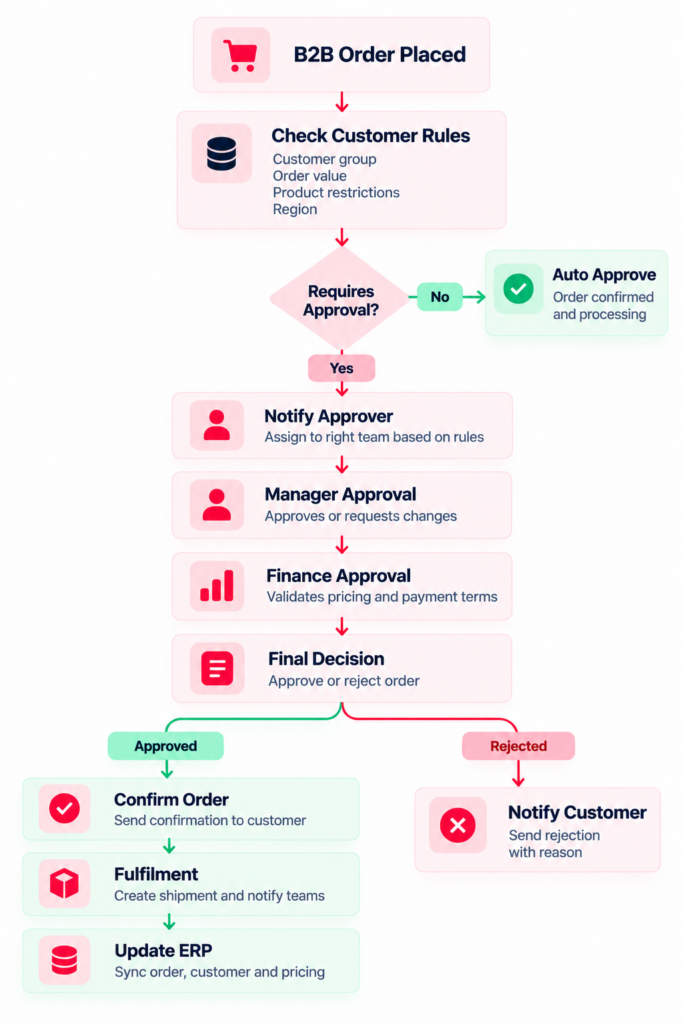
Complex B2B purchasing journeys often involve multiple stakeholders, budget limits, and tiered approval processes. Your sales and customer service teams are stuck managing these workflows manually via email and spreadsheets because your platform lacks native B2B capabilities. This friction frustrates high-value customers and creates operational drag that hinders revenue growth.
The Solution: Modern B2B commerce requires native capabilities for complex purchasing workflows. Workflow automation can handle processes such as multi-step approvals and order notifications, while native support for role-based access, custom price lists, and budget management reduces manual intervention.
From SaaS Constraints to Open Commerce Freedom
Recognizing these five signs is the first step. The next is understanding the architectural difference between a limiting SaaS product and a truly open commerce platform. The distinction is critical for any leader evaluating the ROI of an ecommerce replatforming project.
Capability | Typical Rigid SaaS Platform | Open Commerce Architecture |
Pricing & Rules | Limited native logic; may rely on third-party apps for complex requirements. | Native Rule Builder for complex, customer-specific pricing and business rules. |
Multi-Store Management | Separate instances may be required for new brands or regions, creating additional operational complexity. | Unified management of multiple Sales Channels from a single backend. |
Integrations | Reliance on pre-built connectors can limit flexibility for complex integrations. | API-first foundation designed for deep integration with systems such as ERP and PIM. |
Data & Code Access | Closed architecture with limited access to underlying code and varying levels of data control. | Open-source core provides access to the code and greater control over commerce data. |
B2B Workflows | Basic capabilities may require custom workarounds for complex approval and purchasing processes. | Native B2B capabilities and Flow Builder support complex workflows and automation. |
Reimagine Your Strategy with Enterprise Agility
If these challenges resonate, it doesn’t mean your business has failed; it means you’ve succeeded beyond the limits of your current tools. Moving beyond the expected requires a foundational shift.
At BOLDEST, we believe the right commerce architecture should adapt to the business, not force the business to adapt to the platform. That means evaluating openness, integration flexibility, deployment options, data control, and the ability to support increasingly complex commerce operations.
Shopware is one example of this approach, combining an open-source, API-first foundation with the flexibility to choose between SaaS, PaaS, and self-hosted deployment models.
Shopware brings these principles together in a commerce platform designed to handle complex B2B requirements while giving businesses greater control over their architecture. The goal is not simply to replace one platform with another, but to create a foundation that can adapt as the business evolves.
Ready to Break Through Your Operational Ceiling?
If your commerce platform is starting to limit how your business can operate and grow, it may be time to rethink the architecture behind it. BOLDEST helps businesses evaluate their commerce ecosystem, identify the constraints holding them back, and build a more flexible foundation for what comes next.
Let’s talk about your commerce roadmap.
Action: Contact Us