


For ambitious brands, the rapid launchpad of monolithic SaaS eventually becomes a growth ceiling. This guide provides a strategic framework for C-suite leaders to identify the inflection point where closed architecture hinders innovation and to navigate the path toward open, composable commerce for long-term value and control.
At BOLDEST, we see this inflection point across enterprise commerce: the challenge is no longer simply choosing a platform, but building an architecture that can keep pace with the business.
The SaaS Honeymoon vs. The Enterprise Reality
For many high-growth brands, the journey begins on a platform like Shopify Plus. Its appeal is undeniable: rapid time-to-market, a straightforward user interface, and a vast app ecosystem that promises a solution for every problem. This is the SaaS honeymoon—a period of exhilarating velocity where the primary focus is on launching and iterating quickly.
However, as businesses scale in complexity, revenue, and ambition, they often encounter the “SaaS Ceiling.” This is the critical inflection point where the very architecture that enabled initial speed begins to impose technical, financial, and strategic constraints. The platform’s guardrails, once helpful, become barriers. The all-in-one simplicity masks a growing fragility. This isn’t a failure of the business; it’s a sign that your strategy has outgrown the foundational trade-offs of a closed, one-size-fits-all system. True commerce modernization isn’t just about new features; it’s about reclaiming architectural control to secure future growth.
Symptom 1: The App Ecosystem & The “Fragility Tax”
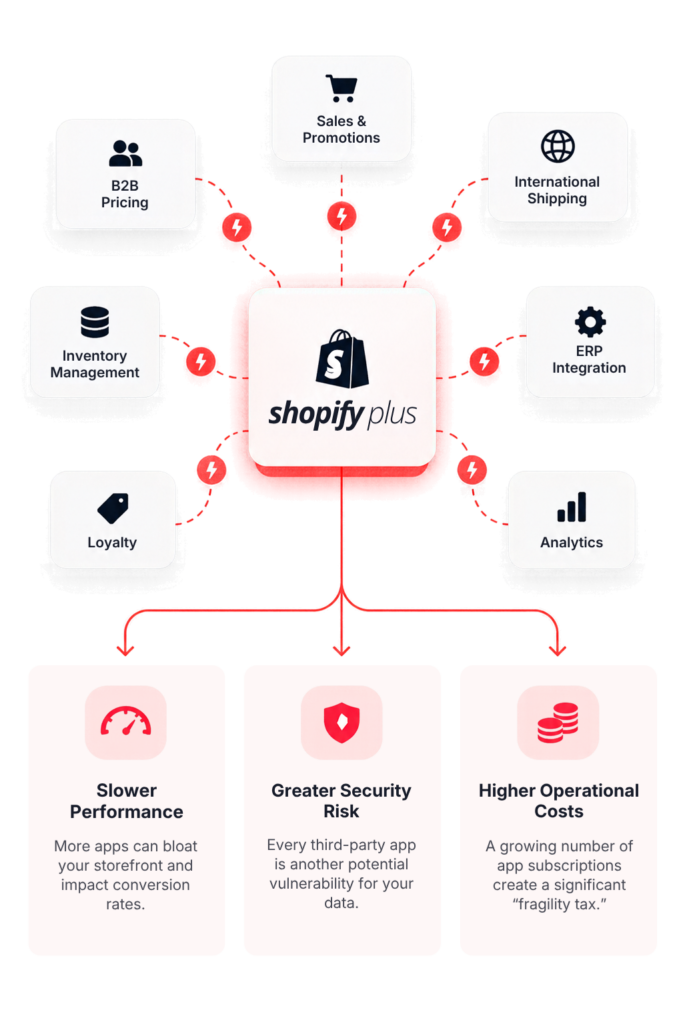
The first sign of strain often appears in the app stack. A once-lean setup balloons to 30, 40, or even 50+ third-party applications to handle everything from B2B pricing to international duties. While seemingly a testament to flexibility, this dependency introduces a significant and often unmeasured “fragility tax.”
- Performance Degradation: Each app adds scripts that can bloat your storefront, slowing down Core Web Vitals, harming SEO rankings, and degrading the user experience—directly impacting conversion rates.
- Cascading Points of Failure: Your core business logic is now fragmented across dozens of vendors. A single app update can break critical workflows, creating a brittle system that requires constant monitoring and firefighting.
- Security and Data Exposure: Every third-party app is another potential vulnerability and another pipeline for your customer data, complicating compliance and increasing risk.
An open, modular platform addresses this by replacing a patchwork of point solutions with deep native extensibility. Instead of bolting on a third-party workflow tool, you can use an integrated engine like Shopware’s Flow Builder to automate complex commercial processes across your entire stack. This reduces dependency, streamlines operations, and puts your team back in the driver’s seat.
Symptom 2: The Complexity Barrier for B2B & Global Commerce
The SaaS ceiling becomes most apparent when a business pursues complex operational models, particularly in B2B and multi-store international commerce. Monolithic SaaS, designed primarily for straightforward D2C, often stumbles when faced with enterprise-grade requirements:
- Advanced B2B Requirements: Managing complex sales structures with role-based access, customer-specific price lists, budget approval workflows, and quick-order tools requires more than a simple app. These are core architectural needs.
- Multi-Store & International Rollouts: Effectively managing multiple brands, countries, and currencies from a single backend is a monumental challenge on closed platforms. Workarounds for localized checkout flows, per-channel tax rules, and distinct domain management become unsustainable.
- Deep Backend Integration: Synchronizing data with a complex IT landscape of ERPs, PIMs, and OMSs requires robust, standardized APIs, not brittle, custom-coded connectors that break with every platform update.
This is where a platform with a powerful, API-first architecture and native components makes a strategic difference. Shopware’s core includes a comprehensive B2B Suite and a Rule Builder that allows you to configure sophisticated pricing and visibility rules without custom code. Its native Sales Channels feature was built from the ground up to orchestrate multi-brand, multi-country operations seamlessly from one admin panel. This is the foundation for scalable complexity, not a collection of workarounds.
Symptom 3: Margin Compression & The True Cost of Ownership
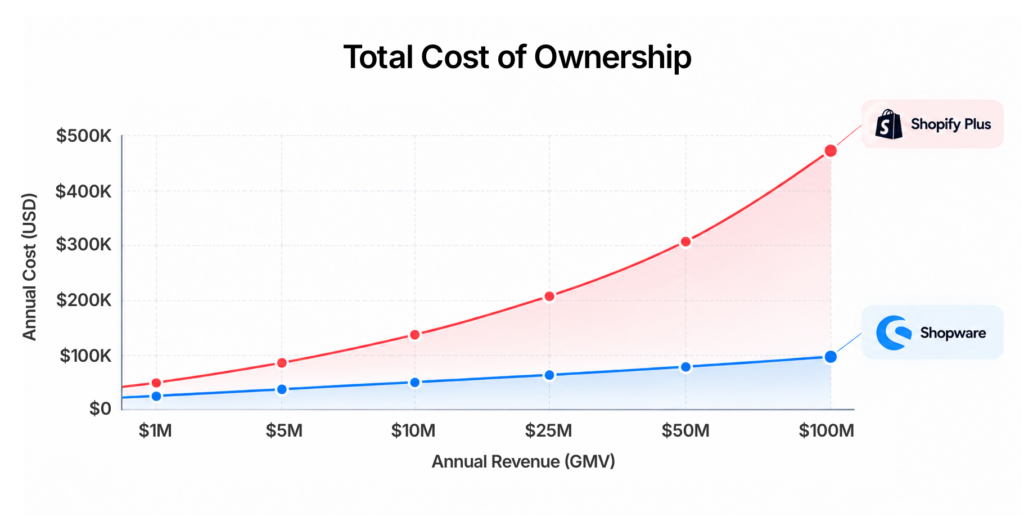
For the CFO and C-suite, one of the most compelling drivers for ecommerce replatforming is the economic reality of closed SaaS at scale. The initial, seemingly predictable subscription fee obscures a TCO model that erodes margins as you grow.
Let’s deconstruct the true cost:
- GMV-Based Fees: A percentage-of-revenue “success tax” that penalizes you for growing. As your revenue scales into the tens or hundreds of millions, these fees become a significant line item.
- Payment Gateway Penalties: Vendor lock-in often extends to payments, where using a third-party gateway incurs additional transaction penalties, limiting your ability to optimize processing costs.
- Cumulative App Subscriptions: The monthly cost of 30-50+ apps creates an unpredictable and steadily rising operational expense that is difficult to forecast.
In contrast, an open platform like Shopware offers a predictable commercial license and complete freedom over your infrastructure. By leveraging Shopware’s flexible deployment models – SaaS, a managed PaaS, or a self-hosted environment, you gain greater control over your operational costs, eliminating the punitive success tax. This move from a variable, revenue-based cost structure to a predictable, value-based one is a critical step in mature financial management for a digital enterprise. Shopware’s case studies show that merchants can achieve up to 60% lower maintenance costs and innovate significantly faster.
The Solution: Architectural Sovereignty with Open, Composable Commerce
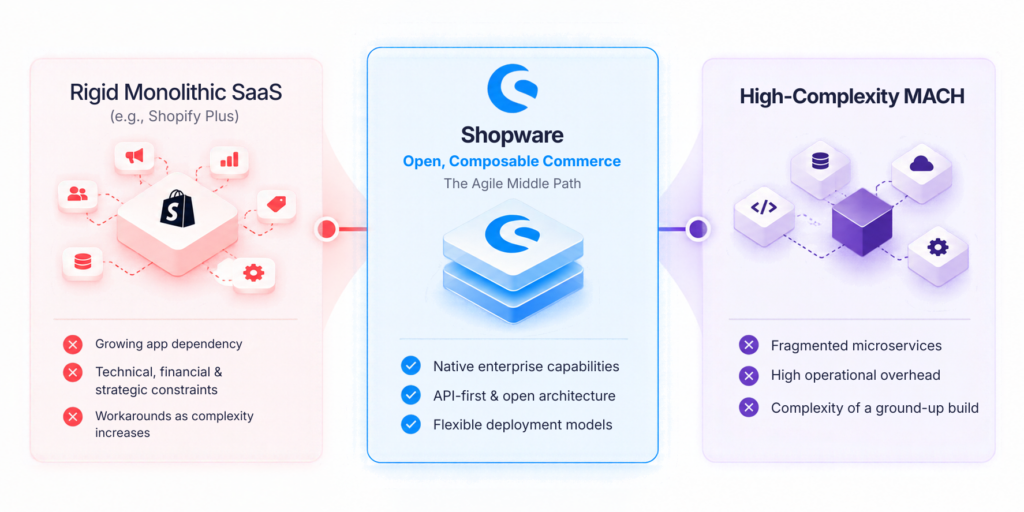
The strategic answer to the SaaS ceiling is not to swing the pendulum to the other extreme of a fragmented, high-overhead microservices project. The solution is a middle path: an open, composable platform that delivers enterprise agility without the lock-in of monolithic SaaS or the operational complexity of a ground-up MACH build. Power your commerce with a platform that adapts to your strategy – not the other way around.
This approach, built on an open-source core and an API-first foundation, delivers architectural sovereignty. It means you own your code, your data, and your roadmap. Shopware is designed to provide:
- Composable Flexibility: Decouple your frontend and backend to create unique customer journeys with any headless storefront, while leveraging a powerful, commerce-centric core that handles the complexity.
- Developer Freedom: Give your engineering teams full code access and the ability to extend the platform without limitation, enabling true differentiation and seamless integration with your existing tech stack.
- Deployment Adaptability: Choose the deployment model that fits your strategy and technical resources—SaaS for simplicity, PaaS for a balance of control and managed infrastructure, or Self-Hosted for ultimate sovereignty. You can even switch between them on the same Shopware core as your business needs evolve.
Strategic Migration & Readiness Checklist
Evaluating the move beyond closed SaaS is a strategic decision. Here are the key questions for your leadership team to determine if you’ve reached the replatforming threshold:
- The Customization Mandate
At what point do our unique business logic, customer experience requirements, and integration needs demand full code and data control that a closed API cannot provide?
- The B2B & Global Revenue Tipping Point
When does B2B become a dominant revenue channel, or when does international expansion become a core pillar of our growth strategy that outstrips our platform’s native capabilities?
- The TCO Inflection Point
At what financial threshold does the cumulative cost of GMV fees, payment penalties, and app subscriptions justify the investment in a platform with a more predictable and controllable cost structure? - The Path to a De-Risked Migration
How can we de-risk the ecommerce migration? An API-first platform facilitates a more manageable transition, allowing for phased rollouts by region, brand, or channel, and ensuring clean data layers from the start. This is where the right technology partner can add value – not just in selecting a platform, but in planning the architecture, integrations and migration path around the needs of the business.
Conclusion: Own Your Digital Destiny
Outgrowing your commerce platform is a sign of success. However, staying on a restrictive architecture past its expiration date transforms a growth enabler into a strategic liability. The move from a closed SaaS environment to an open, composable platform is the defining step in modern commerce for enterprises ready to take full control of their future.
This transition is more than a technical upgrade; it’s a fundamental business decision about agility, ownership, and long-term enterprise value. It’s about building a digital foundation that not only supports your business today but is also engineered to adapt and scale with your vision for tomorrow. Move beyond the expected and put your team in the driver’s seat of your commerce destiny.
Ready to Break Through the SaaS Ceiling?
Discover how BOLDEST can help you evaluate your commerce architecture, navigate the path beyond SaaS limitations, and build a foundation designed to scale with your business.
As a Shopware partner, we bring together commerce technology, experience, data and automation to help ambitious brands build what comes next.
Let’s talk about your commerce roadmap.